
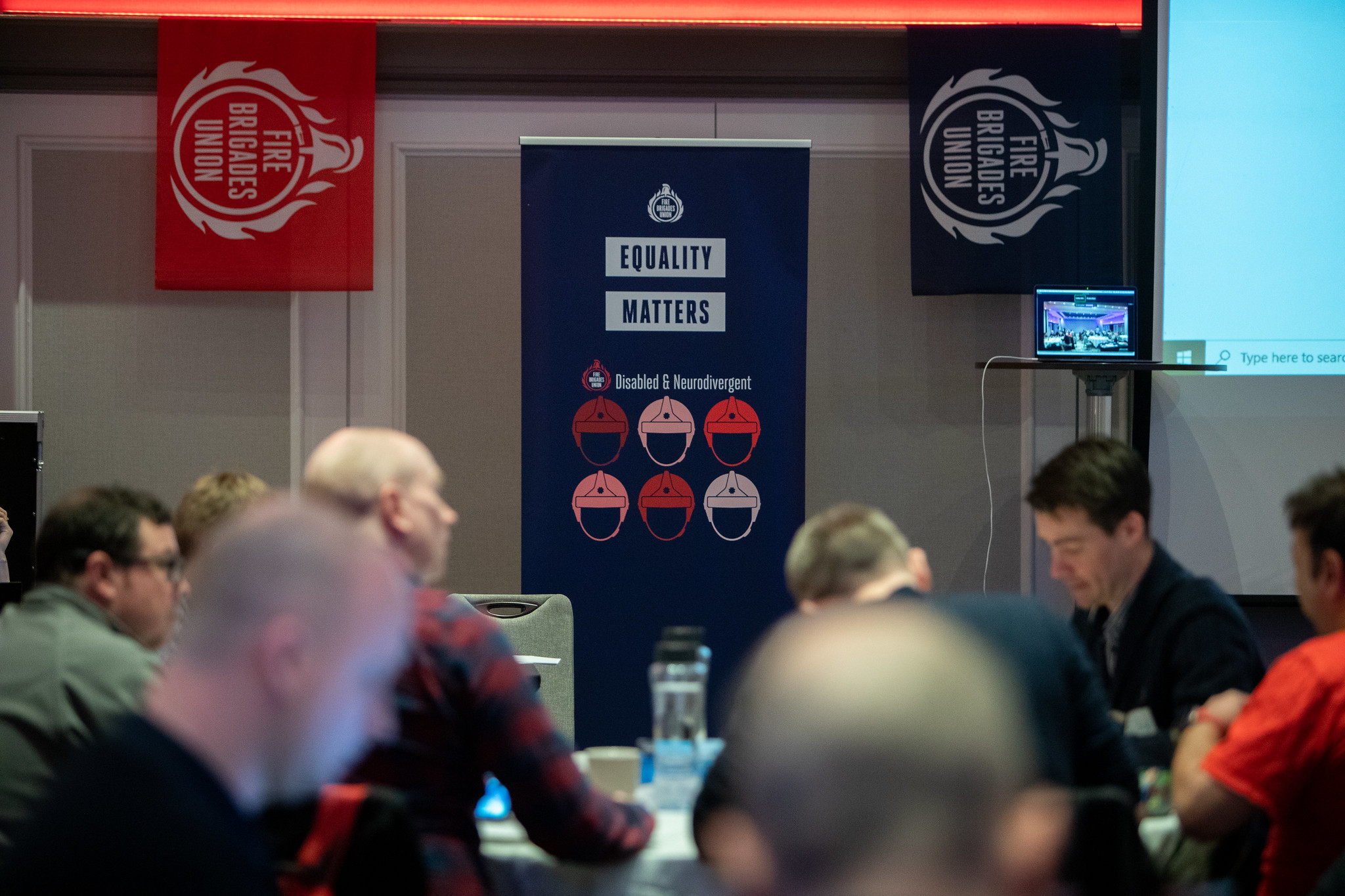
The FBU, much like the communities our members serve, includes people with minds of all kinds and functions, whether that be with autism, dyslexia, dyspraxia, attention deficit hyperactivity disorder (ADHD), or Tourette’s.
It is estimated that approximately 15-20% of people in the UK - or 1 in 7 - are in some way neurodivergent. That number is likely to hold true in fire and rescue services too. This means that hundreds, possibly thousands, of FBU members are in some way neurodivergent.
It is unfortunately clear that neurodivergent firefighters and control staff face significant barriers and challenges at work, often caused by workplace policies, practices and procedures that have been designed without consideration for the vast neurodiversity of our workforce. In a safety-critical industry such as ours, this can jeopardise both
firefighter and public safety.
Rather than remove these barriers, all too often neurodivergent workers are unfairly subject to disciplinary and capability procedures, and are managed
out of jobs they are more than equipped to do. It is also shockingly clear that neurodivergent workers are disproportionately likely to face discrimination,
bullying and harassment at work. This is unacceptable. Neurodiversity should never be a barrier to a long, successful and safe career in any fire and rescue service role.
The FBU will fight tirelessly at all levels of our union to ensure that employers make the changes necessary to update and improve the policies, practices, procedures and attitudes that disadvantage neurodivergent people. This is about fighting for broad and progressive structural changes to our workplaces so that everyone can work safely and without undue stress or risk.
To help achieve this goal, the union provides a range of support to both members and officials, including:
- Access to screening tools to help identify neurological conditions
- Support, representation and advocacy at all levels of the union's structures
- Information, advice and best practice guidance
- Education: Dyslexia and Neurodiversity in the Workplace course. See the Education webpage for more details.
- National organising forums for disabled and neurodivergent members
See below for more information on neurodiversity and FBU support.
Neurological diversity – or neurodiversity – refers to the natural differences in the ways that human brains are ‘wired’.
Neurodiversity is not itself a condition, but a way of understanding human neurological difference. The term describes the broad diversity of ways that we
think and process information.
It asserts that there is no single ‘normal’ type of brain, and that neurological conditions are not disorders, but simply different ways of thinking and experiencing the world.
It is a movement that has sought since the late 1990s to celebrate the strengths and many positives of neurodivergence, while resisting the common view of neurodivergent people as being in some way ‘faulty’.
It is an umbrella term that includes such neurological conditions as ADHD, autism, dyslexia, dyspraxia, dyscalculia, and Tourette’s syndrome. Approximately 15-20% of people in the UK are neurodivergent in some way.
Autism
Autism is a spectrum condition characterised by differences in social interaction, verbal and non-verbal communication, information processing, intensity of interests, sensory sensitivities, repetitive behaviour, and literal thinking. There are numerous strengths associated with autism, including superior memory, analytical/logical thinking, focus, attention to detail, and creativity; as well as personal qualities such as honesty and dedication. Asperger’s Syndrome is now included in autism diagnoses and is no longer diagnosed as a separate condition.
ADHD
ADHD comprises a group of behavioural traits that include inattentiveness, hyperactivity, restlessness, and impulsiveness, as well as difficulties with time
management and organisation. Strengths associated with ADHD include hyperfocus and composure in high pressure situations, as well as resilience, creative thinking, and problem solving.
Dyslexia
Dyslexia is a condition most commonly characterised by difficulties with writing, spelling, and fluent word-reading. It may also include challenges connected to cognitive tasks, such as information processing and retention, working memory, and phonological processing. Dyslexic people often present with enhanced visual-spatial abilities and lateral, big-picture thinking. They excel in pattern-spotting, qualitative reasoning and inventiveness.
Dyspraxia
Dyspraxia most commonly affects fine and/or gross motor skills, causing difficulties with movement, co-ordination, and sometimes speech. This often manifests in general ‘clumsiness’, disorientation, poor balance, and difficulties with handwriting and typing. Dyspraxia does not preclude people from working in physically demanding
jobs and many dyspraxic people score highly for determination, innovation, visualisation, empathy, and inferential reasoning.
Dyscalculia
Dyscalculia is a condition associated with a specific and persistent difficulty in understanding number-related concepts and arithmetical skills. Strengths often lie in oral memory and language, with high degrees of creativity and strong communication.
Dysgraphia
Dysgraphia, while similar to dyspraxia, more specifically involves difficulty with the physical act of writing or typing, often including difficulty spelling, spacing
words, and organising thoughts coherently.
Tourette's syndrome
A neurological condition characterised by a combination of involuntary noises and physical movements called tics. Coprolalia – or swearing tics - affects only
1 in 10 people with Tourette’s syndrome, but 85% experience co-occurrence with ADHD or OCD. People with Tourette’s syndrome display enhanced cognitive control and information processing.
The way that we understand disability at work is important and has very real implications for neurodivergent workers. There are two broad approaches to
understanding disability: the medical and the social model.
The medical model says that people with impairments are inherently disabled and that those impairments should be treated or fixed to overcome any associated difficulties. In practice at work, a medical model approach requires that employees ‘fit in or get out’.
The social model says that people with impairments are not inherently disabled, but are instead made disabled by attitudinal and environmental barriers that commonly exist in society. In other words, disability is a product of the social world, not a biological category. Therefore, the difficulties that neurodivergent people may face at work are not due to their impairment, but are produced by the failure of their employers to create accessible and inclusive workplaces.
Consider the practical consequences of the below statements and how an employer might be required to respond in each scenario:
Jane works in fire control. She is autistic.
Medical model: Jane's autism makes her hypersensitive to bright lights, so she can't work in our control room.
Social model: The bright lights in our control room make Jane distressed as she is autistic and unusually sensitive to light. She can work here if we turn them down.
In these examples, the problem - and therefore the solution - is different. In the former, it is Jane who is the problem: she must either put up with the bright lights or leave her job. In the second statement, the problem is clearly the workplace, and a reasonable adjustment means Jane can continue doing her job.
It is therefore paramount that FBU officials approach neurodiversity using the social model of disability. When members are having difficulties at work, for example when subject to capability or disciplinaries, don’t ask how their neurodivergence causes them difficulties at work; ask how work causes them difficulties, and proceed on that basis.
For a more detailed discussion of the social model, see our Neurodiversity the Workplace guidance.
Neurodivergent workers are disproportionately likely to face discrimination and harassment at work. The law affords disabled workers a number of legal rights and provides recourse to challenge unlawful treatment at work.
The Equality Act 2010, which protects people from discrimination on the basis of certain characteristics, is the most significant piece of legislation relating to disability and neurodiversity. It states that a person has a disability if they have a physical or mental impairment that has a long-term and substantial adverse effect on their ability to carry out day-to-day activities. Here, 'long-term' means that the impairment has lasted, or is likely to last, for at least 12 months; and 'substantial' means more than minor or trivial.
Whether a neurodivergent individual is considered disabled under the law will be judged on a case-by-case basis. Respondents at tribunals may claim that a neurodivergent worker is not disabled, and therefore not protected by the Equality Act, by arguing that the individual's condition is mild and does not have a 'substantial' effect on their ability to carry out day-to-day activities, e.g. Iqbal v Mazars LLP; Herry v Dudley Metropolitan Borough Council. In total, 1 in 5 people in the UK meet the definition of disability as defined by the Act.
A key aspect of the Equality Act is the legal duty exerted on employers to make reasonable adjustments so that work is adjusted to remove any disadvantage a disabled person may face at work. Specifically, the law requires that the employer remedy any policy or practice that puts a disabled worker at a substantial disadvantage as compared to those who do not have the condition or impairment. The obligation to make reasonable adjustments for disability extends through the advertising and recruitment process, as well as to those already in work. It also applies to any performance or appraisal process, promotion and selection situations, and redundancy consideration. Failure to make reasonable adjustments constitutes its own type of disability discrimination. For example, if a disabled employee is dismissed on the grounds of capability, it would be considered unfair and unlawful dismissal if the employer had not made reasonable adjustments first, or had not allowed sufficient time to pass for those adjustments to become effective.
The law protects against both the direct and indirect discrimination of disabled people at work. Direct discrimination occurs when an individual is treated less favourably than others because of their disability. For example, not promoting a firefighter because they have ADHD. Indirect discrimination occurs where rules, policies, practices, or procedures disproportionately disadvantage disabled people. For example, requiring all employees to complete written incident reports or IRMPs to strict deadlines or formats disadvantages dyslexic and dyscalculic individuals.
For a more detailed discussion of the law as it relates to neurodiversity, and for more information on other legal protections, see our Neurodiversity the Workplace guidance.
The FBU works with QS Dyslexia Tests to offer members a dyslexia identification tool called QuickScan, which is accredited by the British Dyslexia Association.
QuickScan is a questionnaire that can identify indicators of dyslexia, as well as dyspraxia and dyscalculia. It takes 10-20 minutes and asks for yes/no answers. It is simple to use on all desktops, laptops and larger tablets (not mobile phones at this time).
If there is an indication that the individual may have dyslexia then this can be discussed with their local management and FBU officials will provide support as appropriate.
If you would like to access a QuickScan assessment please approach the FBU branch official in your workplace or contact your FBU brigade official. They will be able to give you the registration information you need. Once you have that you can access the QuickScan assessment.
Any programme of reasonable adjustments should be agreed by all parties, with specific emphasis on prioritising the neurodivergent individual first and foremost.
There is no ‘one size fits all’ approach to adjustments: what works for one won’t necessarily work for another. There must be a process of ‘back and forth’ as the individual learns what does and does not work for them. An employer simply providing or imposing an adjustment and doing nothing else is not enough. Likewise, dismissing an employee on capability without implementing adjustments, or failing to allow sufficient time for the adjustments to be successful, is unlawful.
Reasonable adjustment passports are recommended as best practice for neurodivergent employees by the TUC. Their purpose is to keep record of what adjustments have been implemented, to monitor how successful they’ve been, and to give a consistency of support when moving between employers/workplaces. They prevent employees from having to start from scratch when their manager changes, or when they change role.
See the link below for some examples of reasonable adjustments in relation to neurodiversity. This is not an exhaustive list and each individual should be supported to identify what works for them.
Written in collaboration with neurodivergent members and officials, this guidance takes a practical and progressive approach to neurodiversity at work that places our members and their experiences front and centre. We hope that this can be both an introduction and an ongoing resource, whatever your experience or knowledge of neurodiversity. This guidance aims to:
- introduce neurodiversity as workplace issue
- demystify jargon and define key terms to challenge misconceptions and ignorance
- highlight common barriers and challenges unique to the fire and rescue service
- address the health and safety implications of not considering neurodiversity
- understand progressive, trade union approaches to neurodiversity
- give confidence in supporting members
- discuss the industrial mechanisms and legislation we can use to remove barriers in the workplace and win for members
- summarise best practice approaches to screening, diagnosis, disclosure, and reasonable adjustments
- introduce the FBU’s campaigning goals to improve equality in the fire and rescue service.
