
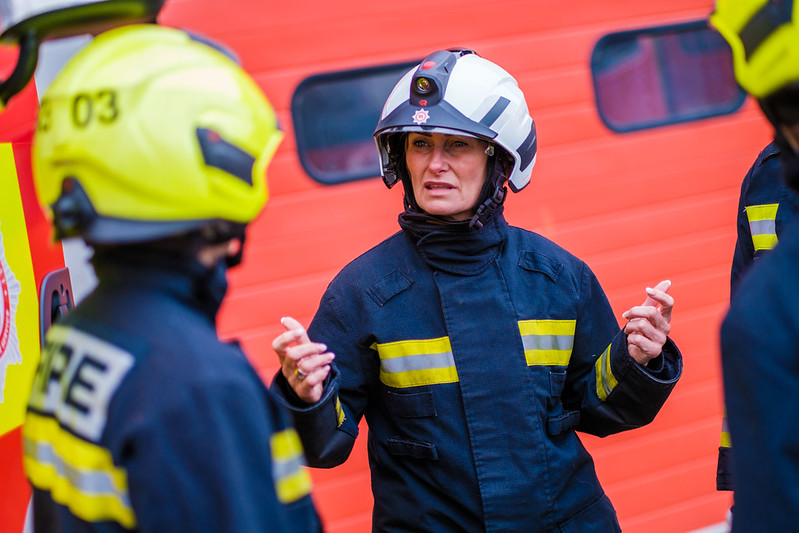
Threats to women’s specific PPE are a safety risk, says the FBU’s National Women’s Committee
In 1996, firefighter Fleur Lombard lost her life in the line of duty. Her death remains a stark reminder that inadequate PPE design can have fatal consequences. Nearly three decades later, the same danger persists: PPE that ignores women’s body shapes leaves firefighters exposed.
This is not about comfort or cosmetics, it’s about health and safety. Ill-fitting PPE restricts movement, creates gaps, reduces grip, and increases the risk of burns and contamination. Too-large boots cause slips, oversized gloves compromise dexterity, and jackets cut for men may leave gaps where flames or toxic substances can enter.
The FBU National Women’s Committee (NWC) fought hard to end this neglect. NWC campaigning led to the creation of SOPHIE, a female-form heat-sensing manikin, commissioned by the HSE. As the HSE report explained: “significant differences in burn injury do occur between male and female manikins wearing the same design of clothing.”
Those differences are life and death. Testing showed that when standard firefighter jackets and trousers were placed on the female manikin, gaps appeared where flames could enter, particularly around the waist and torso. The design, shaped for a male body, left the female form more vulnerable to burn injury. In real fire conditions, that weakness could mean devastating injuries in the very areas the gear is supposed to protect.
Today, women-specific firefighting PPE, used in some brigades, includes additional fire-protective padding around the breasts and hips and wider trouser braces to prevent pressure - and resulting burns - on the chest area. These are not cosmetic tweaks: they are vital safety measures designed to prevent injuries that men’s kit never accounted for. Removing such protections would be a reckless step backwards.
Another HSE test highlighted that identical PPE fitted on the female manikin produced a different burn pattern; air gaps created by the chest shape sometimes reduced burns to the abdomen, but this “protective effect” was inconsistent and unreliable under different PPE combinations. The lesson is clear: only PPE specifically designed and tested for women can ensure reliable safety.
Employers are legally obliged under PPE regulations to provide suitable equipment, free of charge. Suitable cannot mean “scaled-down men’s kit.”
The FBU’s DECON campaign reinforces why this matters. Poor fit doesn’t just risk acute burns, it increases long-term exposure to toxic, cancer-causing contaminants. Protection that doesn’t seal correctly is no protection at all.
Women-specific PPE is not a luxury or an afterthought, it is a legal duty, a safety requirement, and a moral imperative. We owe Fleur Lombard, and every firefighter, nothing less than full and equal protection. We do not support unisex PPE and will challenge this on all fronts.
