
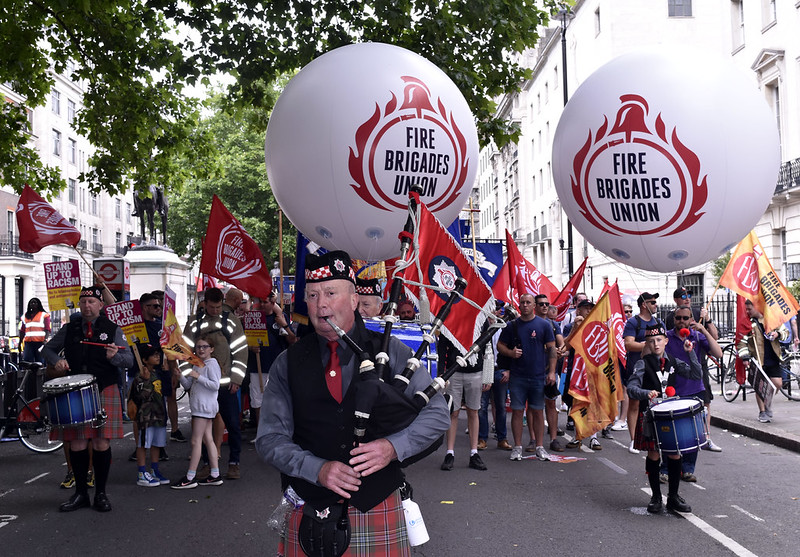
Negotiations on pay reform are continuing at pace between the FBU and fire service employers. The National Joint Council met formally in early October.
The discussions centre on the need for reform to the structure of fire service pay. At present, firefighters do not receive any structured pay progression unless they get promoted.
Nurses, teachers and police officers all get more money with time in the job. There is also a postcode lottery on continuous professional development (CPD) and skills payments, and on maternity pay and other conditions, and inequality between control and operational firefighters. The current system dates back to the Blair era, when a national pay strike ended in a deal which scrapped the fire service pay formula.
“These are complex negotiations, as we are looking to rewire an inadequate pay structure that has been in place for more than two decades,” says Ben Selby, the FBU’s assistant general secretary. “But it is clear that, for pretty much the first time, there is a consensus between us and the employers about both the need for reform and the need for central government investment to make it a reality.”
Between the June and October meetings of the NJC, the FBU gathered brigade and regional officials for national-level meetings, with a view to getting discussions moving at a branch level. Steve Wright, FBU general secretary, says that it was “essential that members discuss our strategy on pay – because what we decide collectively will shape the future of our profession for years to come.” Crucial to the negotiations, and to the FBU’s strategy, is a discussion of the role of the firefighter.
“There is a consensus that the current rolemaps are not fit for purpose and do not reflect the responsibilities set out in legislation,” explains Ben Selby. The latest set of negotiations made some progress in terms of how the role of firefighters might develop.
While there may be some areas where the role could be expanded, the FBU has made it clear that these must be within an agreed framework focussed on blue‑light emergency response.
There may also be scope to discuss some preventative activities, for instance flood defence. “If employers are willing to provide substantial pay uplifts for additional duties,” says Steve Wright, “then that is a discussion that we are willing to have with them – that’s been the FBU’s policy for some years now. But it will all have to be agreed and negotiated, and the FBU’s democratic structures will decide how we proceed.”
The big issue is, as ever, funding. In order to deliver progress on pay, the fire service will need to see substantial investment from central government.
