Francis Beckett explains how the War and the vision of its general secretary transformed the FBU.
The Second World War presented Britain’s fire service with its biggest ever challenge – to ensure the country survived a mass bombing campaign over its cities. The solution was to give the FBU its biggest problem – but also turned out to be its greatest opportunity.
The network of 1,400 small fire services, responsible to local authorities and with different working practices, was not going to meet this new emergency – even if there had been enough firefighters. And there were nothing like enough.
In March 1938 the central government set up the Auxiliary Fire Service (AFS), recruiting new full and part-time firefighters from all sorts of trades and professions.
Some FBU members were not at all certain they wanted these new, inexperienced people in their ranks. They looked like invaders, playing at being firefighters. Their pay was lower than that of most regular firefighters. Worse still, it seemed to some, the AFS people included women. Worst of all, 18,000 new members in London alone could easily outvote the union’s 3,150 existing members.
One member of the union’s executive, a young radical called John Horner, insisted that the FBU could not afford to have the AFS outside the union, or in another organisation – the government might well organise some sort of staff association.
When general secretary Percy Kingdom resigned in 1939, Horner was elected to succeed him, aged just 28.
He set about recruiting AFS members, even though TUC general secretary Walter Citrine said he was “attempting the impossible” in trying to organise “this transient horde”.
After war was declared on 3 September 1939, it quickly became clear that Britain’s fire services badly needed co-ordination. People were dying needlessly because procedures differed from service to service. Sometimes it was not clear who could authorise the deployment of resources – the chain of command might involve the town clerk, the chairman of the main drainage committee, or, in one famous case, the master of Corpus Christi College, Oxford.
So the National Fire Service (NFS) was created, with FBU support. The NFS, Horner told the 1941 FBU conference, was the first “disciplined, uniformed, state-controlled organisation with a union affiliated to the Labour Party and the TUC – part and parcel of the working class movement”.
The FBU called for a national minimum rate of pay throughout the NFS; an end to stoppages from basic pay as a means of punishment; and an end to the system which had left AFS man Harry Errington with a George Cross for bravery, but without a job, because it took him more than 13 weeks to recover from injuries sustained while fighting a fire.
In December 1941 the FBU secured a deal which gave up to 26 weeks of injury pay and higher wages.
Out of nationalisation came the first comprehensive Manual of Firemanship. “This book is one of the results of nationalising the fire service,” noted The Firefighter. “Its scope, as well as its cost, would have put it beyond the capacity of any local authority, while no body outside the service itself could have gained access to all the necessary material.”
4,800 WOMEN
By 1943 there were 4,800 women in the fire service. The FBU had women organisers and was demanding the same conditions for them as for men. The first all-female fire station in the north was established in Northumberland because there were no men to do the work.
Winston Churchill’s appointment of the veteran trade union leader Ernest Bevin as Minister of Labour was a signal of the way the wartime government intended to handle the unions. So Horner and the new chief of the London Fire Brigade, Major Frank Jackson, formed an unlikely but productive partnership. Jackson supported Horner’s efforts to bring the AFS into the union, promised freedom of entry to all stations and facility time for union officials, and said he would make himself available to Horner at any time.
Outside London, some fire chiefs still seemed to equate trade unions with treason. But Horner was on the right side of history. Having been elected leader of a union of 3,500 members, he found himself by mid-1940 with 66,500. Most of the new members were AFS, but the union was also overcoming opposition in the provinces and recruiting more professional firefighters.
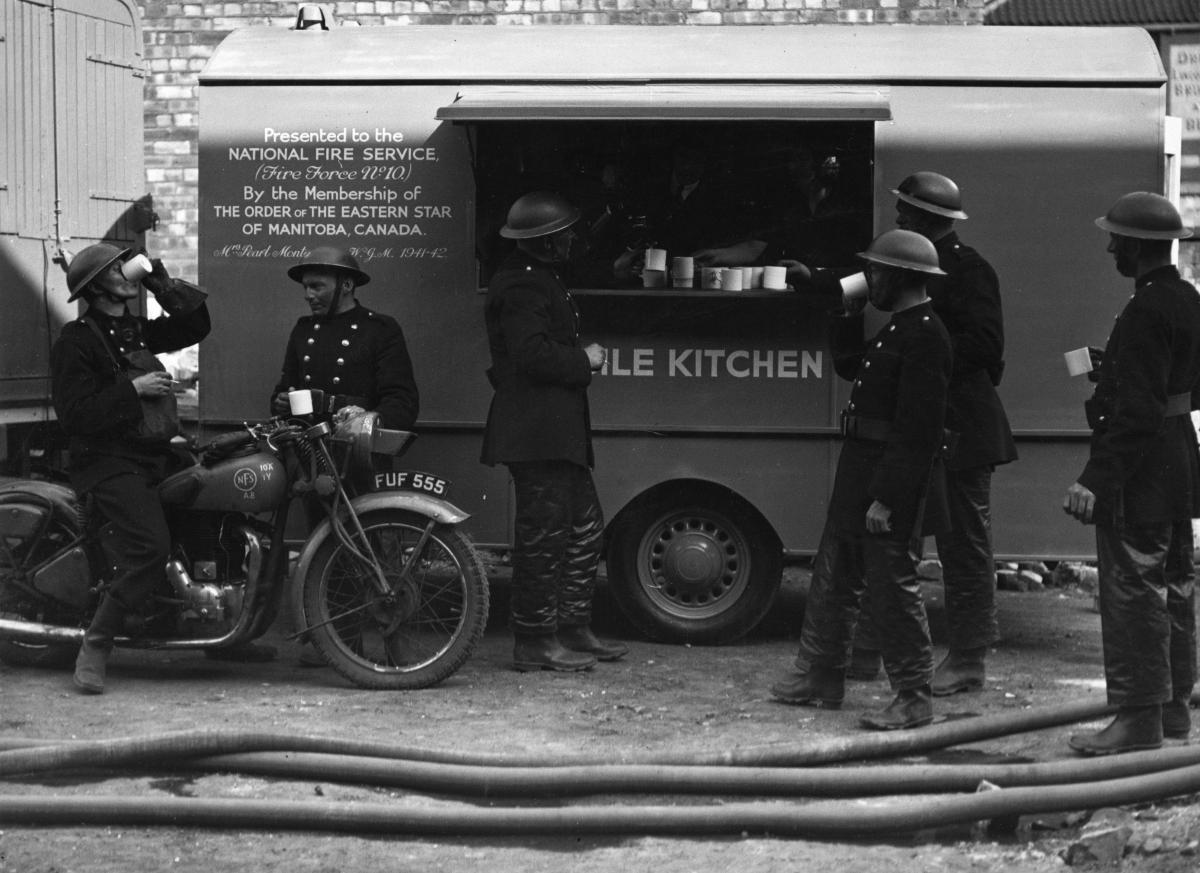
Major Jackson arranged an informal meeting between John Horner and Sir Arthur Dixon, head of the fire services division at the Home Office, for Horner to describe his members’ grievances. Horner wrote later: “I said that we had four mobile fire service canteens for the whole of London. Men cut off from help had been known to drink water from the Thames. We had no emergency rations; the few cooks we had in the stations were at home during the night. Men came back to their makeshift depots, sodden, tired out and filthy, with no means of drying their only uniform and liable to be called out again.”
NATIONALISATION
After the war, the new Labour government was committed to a programme of nationalisation, and firefighters might have hoped that the nationalisation of their service would be permanent. However, in 1947 fire brigades were split and once again organised on a regional basis.
But it was not a return to the pre-war system. The number of brigades was drastically reduced to 135. The home secretary was given power to fix national standards.
A central fire brigades advisory council, consisting of the main professional and governmental organisations, including the FBU, was formed to advise the home secretary on national policy.
There was to be a national pension scheme, as well as national standards for attendance times and for equipment, as the FBU had always wanted.
The union had come out of the war as a force in the land – not just a body to negotiate pay and conditions, but a professional voice as well.