Mark Rowe, FBU national officer explains how the public inquiry hearings concluded and what happens next
The Grenfell Tower fire was the worst domestic fire in living memory, when 72 people died and a whole community lost their homes. This year, 14 June will mark the sixth anniversary since the atrocity, yet nobody has yet taken responsibility for the fire nor been held to account by the courts.
On 10 November 2022, the Grenfell Tower Inquiry (GTI) held its last hearings, more than five years since it was established. After more than 300 days of hearings, the inquiry finally finished taking evidence on what caused the fire.
MANUFACTURERS
Richard Millett KC, lead counsel to the inquiry, concentrated on the behaviour of the various manufacturers, sub-contractors and other local politicians involved in the refurbishment of Grenfell Tower. In particular, he pointed the finger at those who made, sold, recommended and installed the flammable cladding.
Millett opened the inquiry hoping that it would not be a “merry-go-round of buck passing”. He closed it by accusing manufacturers Arconic, Celotex and Kingspan, contractors Harley Facades, Rydon and Exova, and architects Studio E of deflecting blame to others.
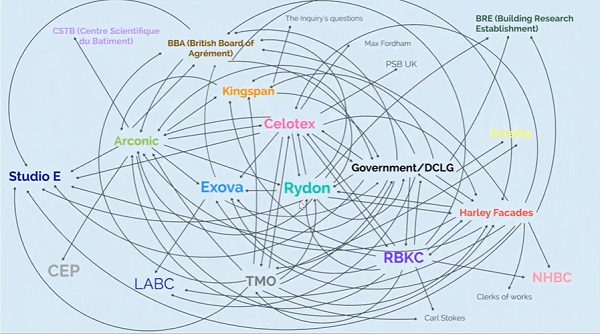
He displayed a “web of blame” diagram to show how firms involved in the refurbishment had not admitted their own roles in the fire.
“If everything that has been said is correct,” he argued, “then nobody was to blame for the Grenfell Tower fire. Can that really be right?”
Millett did not spare the Royal Borough of Kensington and Chelsea, which owned the building, nor the tenant management organisation which ran it, from criticism. Culpable too was the privatised Building Research Establishment (BRE), which knew the risks of cladding materials but failed to warn users about them.
Central government, responsible for the building regulations and approved document guidance, came in for some rebuke.
DEREGULATION
Martin Seaward, the FBU counsel for the inquiry, used his closing statement to emphasise the responsibility of central government ministers for their deregulation policies.
Deregulation informed government policy since 1979 and has remained the mantra of the current government, despite Grenfell
He said: “The disaster was a direct consequence of a generation of government policies which combined to create a death trap for the residents of Grenfell Tower.
“The private sector companies involved in the refurbishment bear a heavy responsibility; however, it would be wholly wrong and provide no justice to victims to leave the blame there …
“They were encouraged to act as they did by 40 years of political decisions in the service of an ideology based on the prioritisation of commercial interests and profit above all else , including public safety …
“Deregulation serves the interests of a social system based on profit and greed, has led to gross inequality in society, and has failed the vast mass of the UK’s population, including the residents of Grenfell Tower.
“The culture of health and safety has been deliberately and irresponsibly undermined by ministers pursuing their deregulatory agenda …
“Deregulation informed government policy since 1979 and has remained the mantra of the current government, despite Grenfell.”
EVACUATION
Two weeks after the close of the hearings and three years since the inquiry recommended it, the Home Office finally published its research, Evacuation from fire in high-rise residential buildings: a rapid evidence review.
Quietly, it admitted that simultaneous evacuation of high rise buildings is extremely difficult, with few safe procedures and little international guidance.
This is further proof – if it were needed – that firefighters and control staff were not to blame for the fire or the deaths on the night.
THE FIGHT CONTINUES
The FBU has been a core participant in the inquiry from the beginning. Last year the union made several detailed submissions, thousands of words long, to demand justice for the victims of the fire, to defend our members and to hold ministers and the construction industry to account.
Later this year, the inquiry is expected to publish its final report. The FBU will evaluate it and produce its own response.
The inquiry’s report is likely to reverberate through the fire and rescue service for many years to come.
The FBU will accept sensible recommendations and work to improve our service. But the union will never concede to private sector takeovers or blaming firefighters for the mistakes made by ministers and chief fire officers.
The web of blame’ – a diagram to show how organisations involved in the refurbishment of Grenfell Tower had not admitted their own roles in the fire (image courtesy of the Grenfell Tower Inquiry)