
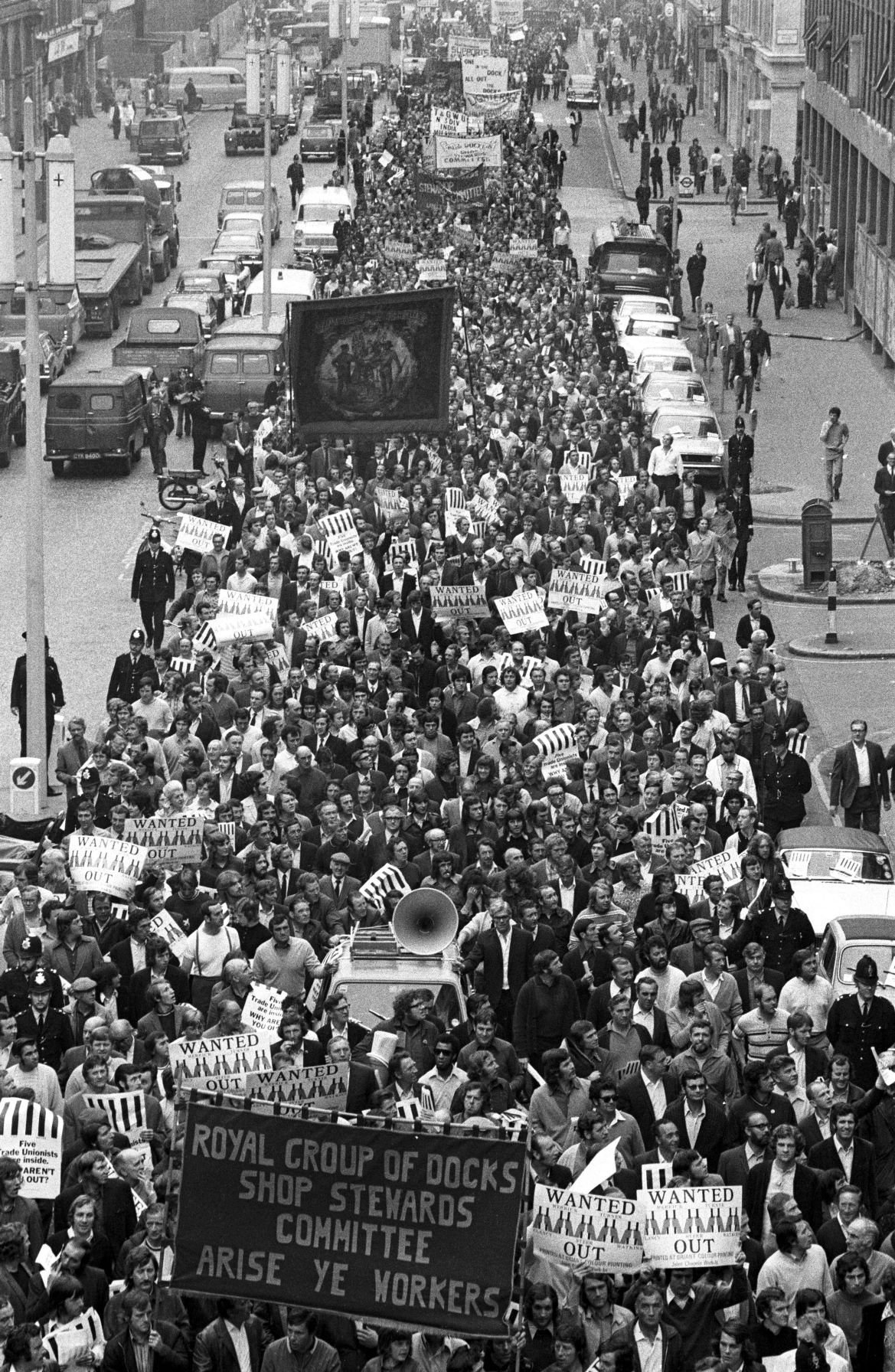
The release from prison 50 years ago of five trade unionists jailed for defending jobs is a key moment in UK history with lessons for today, writes Will Stone
Photo credit: Peter Arkell/reportdigital.co.uk
Fifty years ago five London dockers who had been imprisoned after ignoring a court injunction to stop picketing as part of a campaign to save their jobs, walked free from Pentonville prison.
A massive upswell of solidarity from across the labour movement and beyond had forced the hand of the Conservative government of the time.
On Friday 21 July 1972, the dockers who came to be known as the Pentonville Five - Vic Turner, Tony Merrick, Bernie Steer, Conny Clancy and Derek Watkins - had been arrested after ignoring an injunction by the National Industrial Relations Court to stop picketing the Midland Cold Storage Company in Hackney, East London.
Six days later, with a TUC-backed striken looming, the five were released.
The shop stewards were fighting for jobs and against attempts by bosses to use the introduction of shipping containers to rationalise and deskill their industry - part of an age-old fight against new technology being used to undercut workers' job security, pay and conditions, that is being seen today in many workplaces with increasing automation, digitalisation and artificial intelligence.
Attack on every worker
Speaking on the picket-line at the time, Vic Turner said: "This attack is on every industrial worker in the country, whether he's organised or unorganised.
"People outside the trade union movement better get the message, because it's going to come home to them, very, very shortly."
The Pentonville case came at a time of increasing strike action against attacks by the Tory government of the time, with 1972 seeing the highest number of strikes since Britain's only general strike in 1926.
The then prime minister Edward Heath was determined to get the upper hand over increasing trade union militancy, introducing anti-trade union laws. The Industrial Relations Act the previous year, established the National Industrial Relations Court.
But government attempts to make an example of the five backfired after tens of thousands of dockers walked out on strike the day they were imprisoned.
The national shop stewards committee had passed a resolution saying that if any worker in the country was touched as a result of the Industrial Relations Act they would take action.
The mass walkout of dockers was soon followed by solidarity strikes by Fleet Street print workers, seeing national newspapers shut down, as well as from miners and workers in construction, transport, at factories, post offices and other public and private sectors.
Workers then picketed Pentonville prison en-masse. Maurie Day, a close associate of Mr Turner, described the atmosphere as "electrifying" with people coming from all walks of life to support the pickets and hand out refreshments including tea, beer and soup.
Squatters occupying a nearby building also invited striking workers and their supporters over for refreshments and a kip.
One supporter, Ian Olley, said: "The majority of people who did go to Pentonville and on marches had actually stopped work, and so the employers were really getting one up where they didn't like it.
"It really was a time where you really thought something was going to happen.
"I think that's one of the reasons why they did let them out eventually, because I think the whole situation was getting a bit too f***ing dangerous for them."
His hunch was probably right. No sooner had the TUC called for a one-day general strike on Monday 31 July unless the five were freed, than the government's Official Solicitor stepped in and secured their release.
The only lessons perhaps we can draw are the lessons that no-one, certainly not the establishment, is going to take any workers on when that class is absolutely united and backed up by other people.
By this time more than 250,000 workers had taken unofficial strike action.
The Pentonville Five were carried from the prison on the shoulders of supporters under the banner "Arise Ye Workers".
Tony Merrick remembers hearing the news first from warders and prisoners that they were getting out. He said: "Before I knew it we were at the gates, on the shoulders and away."
Each of the five gave speeches outside, thanking workers and supporters. Bernie Steer told the crowd: "The five of us were put in by a political court, and it was the trade union movement that got us out.
"We're so overwhelmed with the support we've got from you, because without you we'd have rotted in there and make no mistake about it."
Anti union laws
Unfortunately, anti-trade union laws are very much alive and kicking under today's Tory government. Just this month, Conservative MPs backed legislation allowing agency workers to break strikes.
The move comes amid a "summer of discontent" with the first national strike action on British railways for a generation, as well as separate strikes at post offices, courts, universities and colleges.
Other workers have also threatened strike action over insulting pay offers as inflation soars, including firefighters, civil servants, teachers and NHS staff.
Bernie Steer, the last surviving member of the Pentonville Five, who died this July, speaking after being released, summed up what the historic events of 50 years ago mean for today's struggles.
He said: "The only lessons perhaps we can draw are the lessons that no-one, certainly not the establishment, is going to take any workers on when that class is absolutely united and backed up by other people."
