
Westminster government has published a fire and rescue service white paper attacking firefighters' rights as workers.
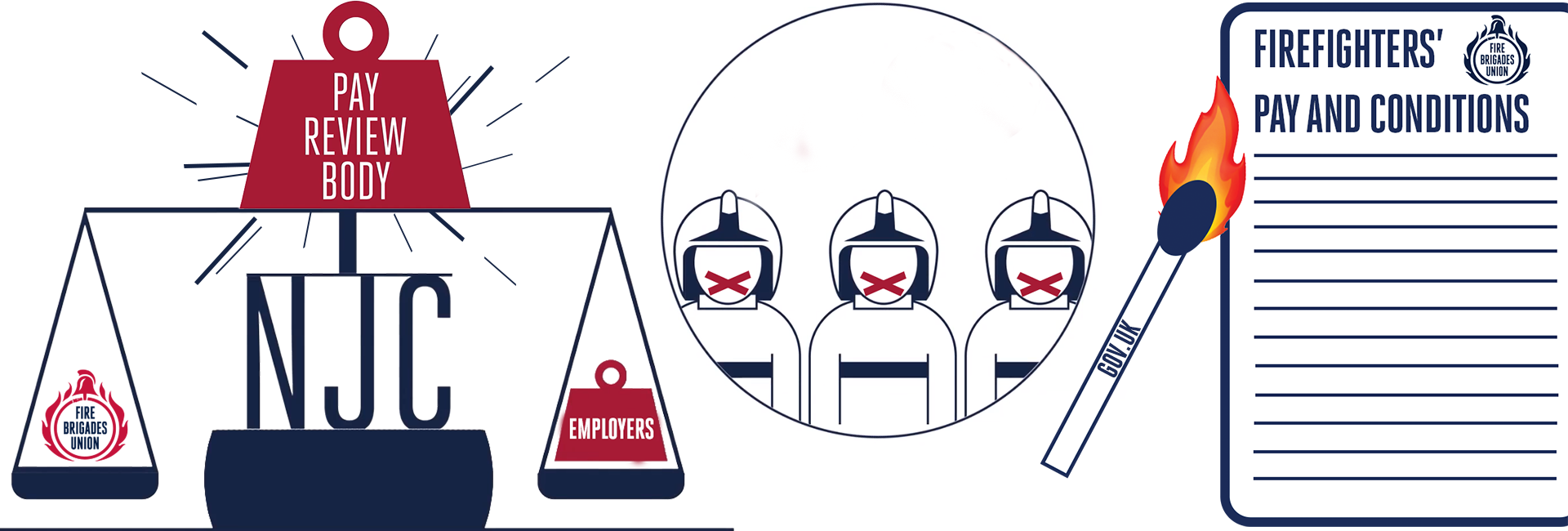
Central to this attack is a review of pay, with proposals to undermine collective bargaining. If the government gets their way, the voice of firefighters and control operators in their pay, conditions and service will be significantly weakened.
The document also suggests that Police and Crime Commissioners could take over more fire services, weakening local communities’ say in how their service is run.
We will not stand by and allow ministers to bulldoze our service, members’ hard-fought for terms and conditions, nor our seat at the table.
Firefighters are ready to stand up, speak up and defend our say in our service.
Take action
With you by our side, we can stop this attack from Westminster government and protect firefighters' voice in their pay, conditions and service. Email your MP and call on them to stand with firefighters.
The challenges we face
What is the National Joint Council (NJC)?
- The NJC is the body where the Fire Brigades Union meets with fire and rescue service employers representing fire authorities and fire boards. The FBU negotiates with employers over firefighters’ pay, terms and conditions, giving firefighters a voice and securing the best possible deal for firefighters and control operators
What does the government want to do with the NJC?
- The government wants to weaken firefighters’ collective bargaining rights and has declared its intention to review the NJC. This could lead to the dismantling of the NJC and the imposition of a pay review body
What is a pay review body (PRB) and how does it work?
- A PRB is made up of government-appointed individuals, who are set a remit by the government. This remit includes a maximum pay threshold which the PRB cannot exceed in its recommendations
- The PRB is tasked with looking at this and other issues, such as workloads, and hears evidence from the trade unions representing the sector of workers and from the employers. The PRB then makes recommendations to the government
- In other sectors where a PRB has been imposed, such as education, the PRB can alter the work (rolemap)
What would a pay review body mean for firefighters?
- Firefighters’ voice in their pay and conditions would be weakened. At the NJC, FBU reps have a seat at the negotiating table. PRBs are not negotiating bodies.
- Without a seat at the negotiating table, firefighters could find their pay and conditions worsening. The PRB could make a variety of recommendations without taking account of firefighters’ views – and the government has the power to accept or reject these recommendations
What is the government proposing to do in relation to firefighters’ rolemaps?
- The government has hinted that they are of the view that chief fire officers should be empowered to impose additional work on firefighters without negotiation. There is a real possibility they want to be able to order firefighters to undertake any work without question or challenge
- The FBU has always been open to clarifying and, in some instances, expanding the role of firefighters. However, any changes must be properly negotiated with firefighters and their union
- The Grey Book is negotiated by the NJC and provides the basis of firefighters’ contracts as employees of UK fire and rescue services, providing national standards in their working conditions. This threat with regards to reviewing how firefighters’ roles are defined could see attacks on the Grey Book.
Why is this a threat to members?
- Anything that could see firefighters and firefighter control left without a say over new areas of work is incredibly dangerous, both for firefighters and the public. Not only could unsuitable areas of work be added, but the training and procedures around these areas could be left completely up to chief fire officers.
What is the threat?
- Proposals set out in the white paper could see more Police and Crime Commissioners (PCC) taking over fire and rescue services. PCCs have oversight of the police service, while the fire and rescue service has separate governance arrangements. There is a distinct lack of appetite from firefighters, the public and local authorities for PCCs to takeover fire service governance.
- It would hinder firefighters’ ability to carry out life-saving work. The fire service is a humanitarian service, firefighters are not law enforcers and their neutrality allows them to reach out to all sections of their community. Giving PCCs control over the fire service would blur the boundaries between the fire service and police force
- The fire service would be used to prop up the police force. When Boris Johnson was Mayor of London, fire service reserves were used to fund the police force while the fire service was cut. If further cuts were introduced, fire services would likely be hit first
What impact would this have on the local community?
- It would weaken local communities’ say in their service. Fire services in England are generally managed by fire and rescue authorities made up of elected local councillors. They are accountable to their community and all of their decisions are taken in public. By contrast, PCCs have a weak, appointed scrutiny boards where fire would likely be the last item on the agenda
What impact would this have on firefighters?
- It would threaten firefighters’ terms and conditions and current contractual rights. PCCs would have the power to introduce new work streams and set terms and conditions across the police force and fire and rescue. It could directly threaten the resilience of the fire and rescue service through potential redundancies, cuts to posts and downgrading of pumps and stations
