
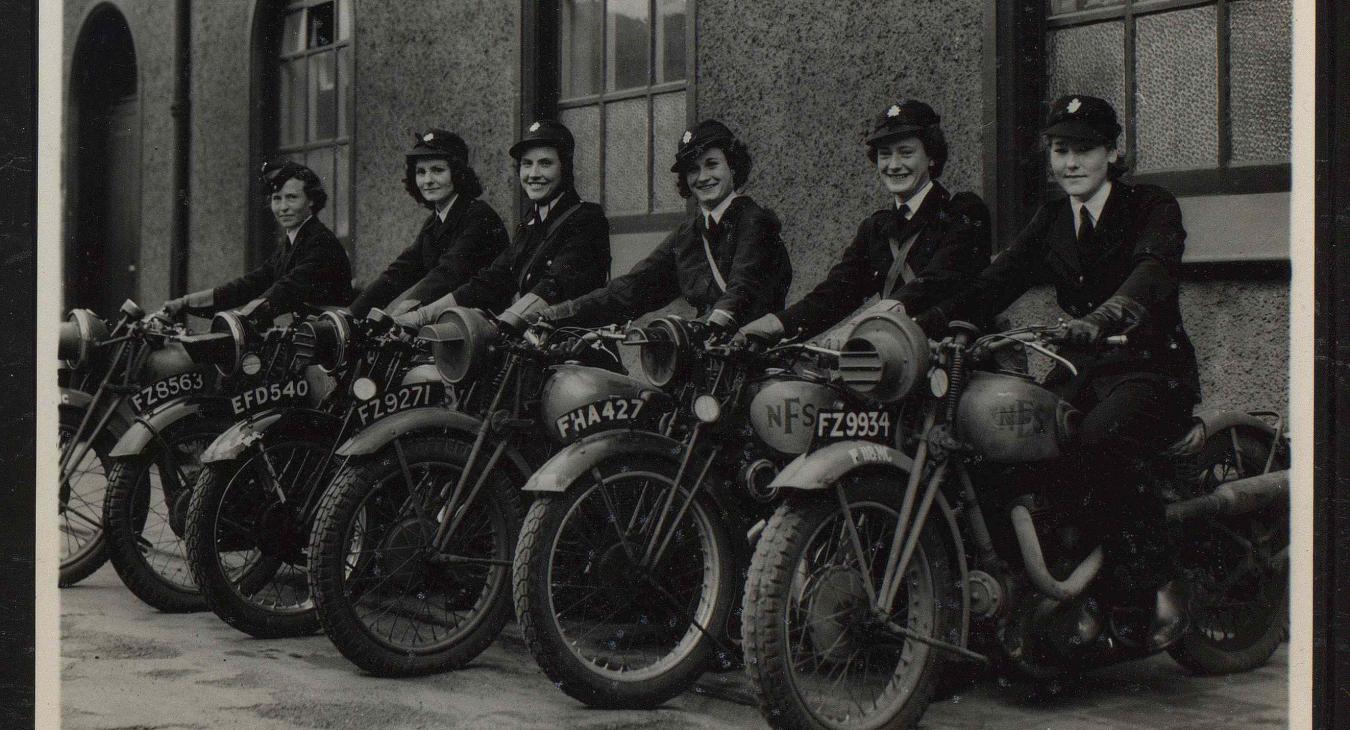
Twenty-five female firefighters lost their lives during the Second World War – some of the forgotten heroines of the home front, writes Lynne Wallis
Women worked as firefighters long before the Second World War. They were employed by private brigades and others like the one attached to the feminist Girton College in Cambridge, the first all-women “brigade” in the UK where students were taught by Captain Sir Eyre Massey Shaw, the first chief fire officer of the Metropolitan Fire Brigade.
Women’s brigades fought fires and carried out some rescues during the first world war, mostly in the South. It was not until the outbreak of the Second World War that large numbers of women began to play a more significant role in the Auxiliary Fire Service (AFS).
The AFS was formed in 1938, when a huge recruitment drive was launched to attract women, as their fathers, brothers and husbands were signing up to join the army.
In the mid-30s there were still only 4,272 professional firemen in the whole of the UK, nearly half of them with the London Fire Brigade.
The AFS, however, was 100,000 strong when war broke out in September 1939, potentially posing a considerable threat to the regular fire brigade. To add insult to injury, as some saw it, women were being allowed to join.
It was not a popular move with many of the men in positions of authority in the service. One chief officer refused to admit women, declaring: “I would rather resign than be made to drill young girls and women to be firemen”.
But sentiments like these had little impact, with numbers increasing from 5,000 in 1940 to 20,000 six months later in 1941, the year the AFS was put under government control and renamed The National Fire Service (NFS). By 1943 more than 90,000 women were enrolled in the NFS.
DRIVING IN PITCH DARK
Women were not expected to extinguish fires, but some did. Most were drivers and despatch riders, a more perilous job than it sounds as it involved driving in pitch dark during enemy air raids.
Many worked in control, usually putting in very long hours, but the women who attended air raids and fought fires alongside men seem to have been written out of history.
According to the 1951 history of the FBU, Fetch The Engine, there were cases of firewomen “unofficially” turning out with men to fight fires during the war.
An internal Home Office memo from 1941 states that women’s duties were telephone and watchroom work, although it accepted that “it is not inconceivable that ultimately women may be accepted for observation duties and even as pump operators”.
Former FBU official Terry Segars writes in a later FBU history, Forged in Fire: “The reality … was that firewomen were more widely involved in active work than is generally acknowledged, and they could often be found in the midst of things during the blitz, whether helping out on the pumps, in control rooms close to the centre of the severest raids or delivering supplies to firefighters.”
Twenty-five firewomen lost their lives during the war.
GEORGE MEDAL FOR BRAVERY
Twenty-one-year-old Gillian Tanner was awarded the George Medal for bravery when she delivered petrol to fire pumps around Bermondsey while the docks were being bombed during the second Great Fire of London in 1940.
Some firewomen were doing well forming “women pump crews”, only to be removed in areas such as Rochester in Kent where there were shortages of control operators. When women were needed for more “masculine” duties, they stepped up to the plate. The first all-woman fire station in the North, established in Northumberland, came about quite simply because there were not any men to do the work.
But these women only got two thirds of mens’ pay until the national service was launched when things improved a bit.
An FBU women’s national conference in 1943 argued in favour of equal pay, but claims were rejected by the Home Office on the basis that equal pay for equal work was not generally accepted.
Female FBU membership grew during the war years from 1,000 in 1941 to 5,500 in 1942. By 1948 numbers had dropped to just 500 as the women who had been doing this vital work went back to their previous lives. Those that stayed tended to work in control rooms.
It took another 30 years for the debate about women in operational roles to re-emerge. East Sussex recruited a woman firefighter in the late 1970s. But it took the pioneering work of the Greater London Council in the early 1000s to re-open serious debate about women in the fire service. By that time, many had forgotten the outstanding contribution made by women to the fire service during the Second World War.
I wonder what Gillian Tanner and all the thousands of other women who served their bombed out communities during the war would have made of the debates of the past 30 years. They really do seem to be firefighting’s forgotten heroines.
