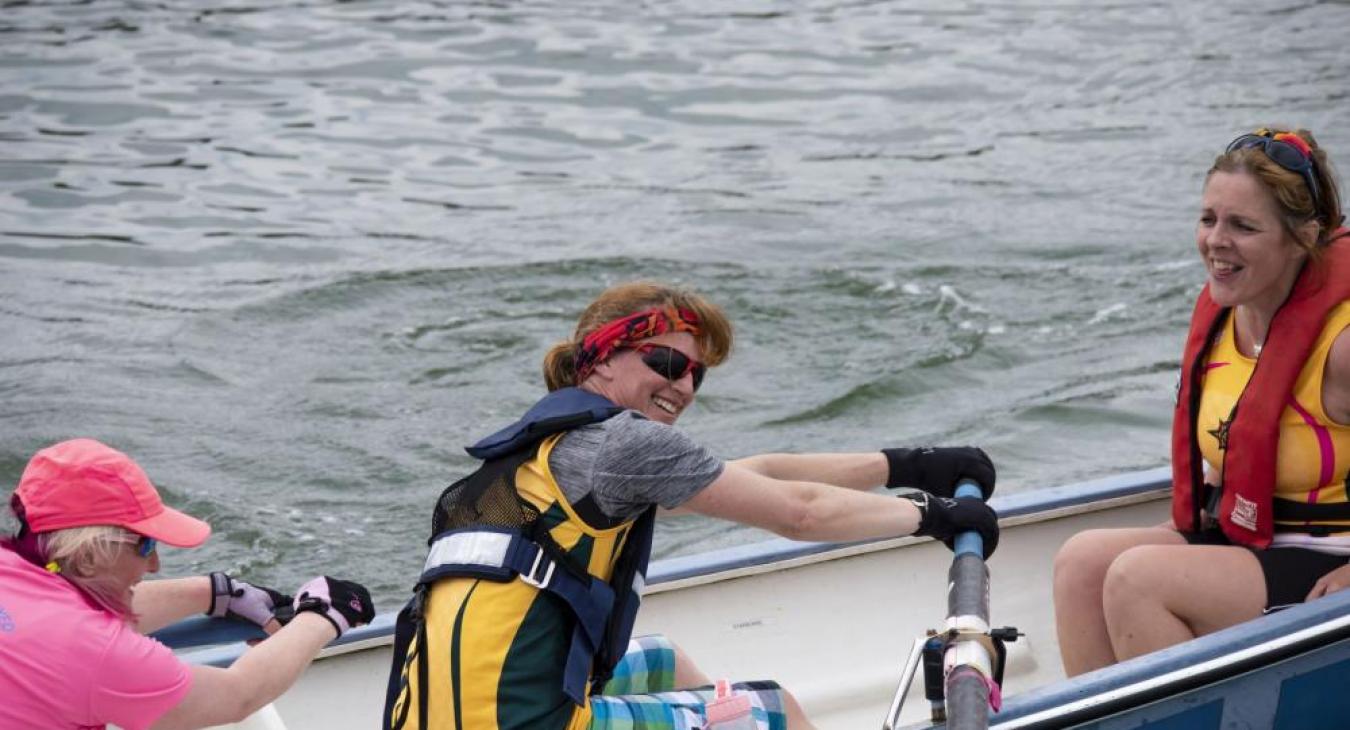
When Hannah Lodder walked past the Llangrannog rowing club on the West Wales coast two and a half years ago, she thought joining could improve her social life.
And she certainly wasn’t wrong. But what Hannah maybe didn’t realize was just how immersed she would become – as key team player, organiser, motivator and gold winning athlete. She has excelled at the club – and rowing has even become a bit of a family affair: her two teenaged sons and partner have got the taste for it too.
It didn’t take long for the Mid and West Wales fire safety watch manager to get stuck in. Soon after signing up to the club, Hannah was asked to join the Celtic Challenge team, which was about to start rigorous training for the world’s longest rowing race.
Every two years, Celtic longboats, crewed by four rowers and a cox, leave Arklow in Ireland for the 96-mile marathon row across the Irish Sea to Aberystwyth. In the race against time and fatigue, crew members are swapped every hour to stave off burnout and maximize speed – boarding and leaving the longboat as support boats draw up alongside.
Last year, a BBC documentary Taking on the Irish Sea followed the Llangrannoch crew in the run up to the 2019 Challenge. Funds and sponsorship had to be found: the FBU donated caps so the union’s logo rode the waves. Hannah, the FBU’s regional education and learning rep, raised £700 for the Firefighters Charity.
She is billed on screen as the fittest rower in the longboat crew but brings far more than her fitness to the sport. With a 22 year- long firefighting career so far; team working, thinking on her feet and assessing risk seem hardwired – a perfect fit for her role at the rowing club. Her take on challenges is simple and inspiring: “If you want to do it you can do it. You’ve just got to put your mind to it”.
Hannah is a big fan of the FBU National Women’s School held at Wortley Hall, for its role in supporting and encouraging women, forging the bonds of sisterhood and solidarity to get a better deal for members. She was a long time regular – and her sons have also enjoyed the ‘Worker’s Stately Home’. So it’s hardly surprising that she’s glad the club’s Celtic longboat is named after local heroine, bard, and pioneering sea navigator, Sarah Jane Rees, better known by her bardic name of Cranogwen.
In a tough field, the Cranogwen team of eight women and four men, aged twenty to sixty-seven, won the Celtic Challenge “miscellaneous” category, coming in fifth overall at 19 hours twelve minutes – taking six hours off the club’s previous record.
Within a year of joining, Hannah was captaining the club in the South and Mid Wales league, picking teams and organising events promoting inclusive indoor rowing in local schools and leisure centres.
She got into indoor rowing when training for the Celtic Challenge, using the Concept 2 rower, an air resistance rowing machine, which allows people to compete internationally, breaking records, for however short a time. In Lockdown Britain, with gyms shut and contests cancelled, there has been a surge in competing.
It’s also a great way to train for races – Hannah installed one in her front room when training for the Celtic Challenge and hasn’t looked back. As Firefighter went to press Hannah was “top of the table” for the 10k lightweight aged between 40 and 49, after “smashing it” at 41 minutes. Hannah’s previous best time was soon bettered a few months back.
There are also more structured competitions. At home, back in June, she took part in the Welsh Rowing Virtual Coastal Championships, coming third in the virtual sea sprint and beach sprint – and a “two together” race with 15- year-old son Max.
In November she won double gold at the Welsh Indoor rowing championships in Cardiff - the lightweight 2k and the 500 metres.
Coach Leo O’Connor, who encouraged Hannah to train for the Celtic Challenge, says she is ‘a rower we all respect and a friend who goes out of her way to support us all in the rowing community.” He added ‘a “rower, leader, mentor and coach - I’m looking forward to what lies ahead for Hannah”.
Well, there’s the Welsh Indoor National Championships in November – and of, course, the Celtic Challenge next spring – if social distancing allows - and lots of inclusive outreach to spread the work that rowing is not just for those who can go for gold.