
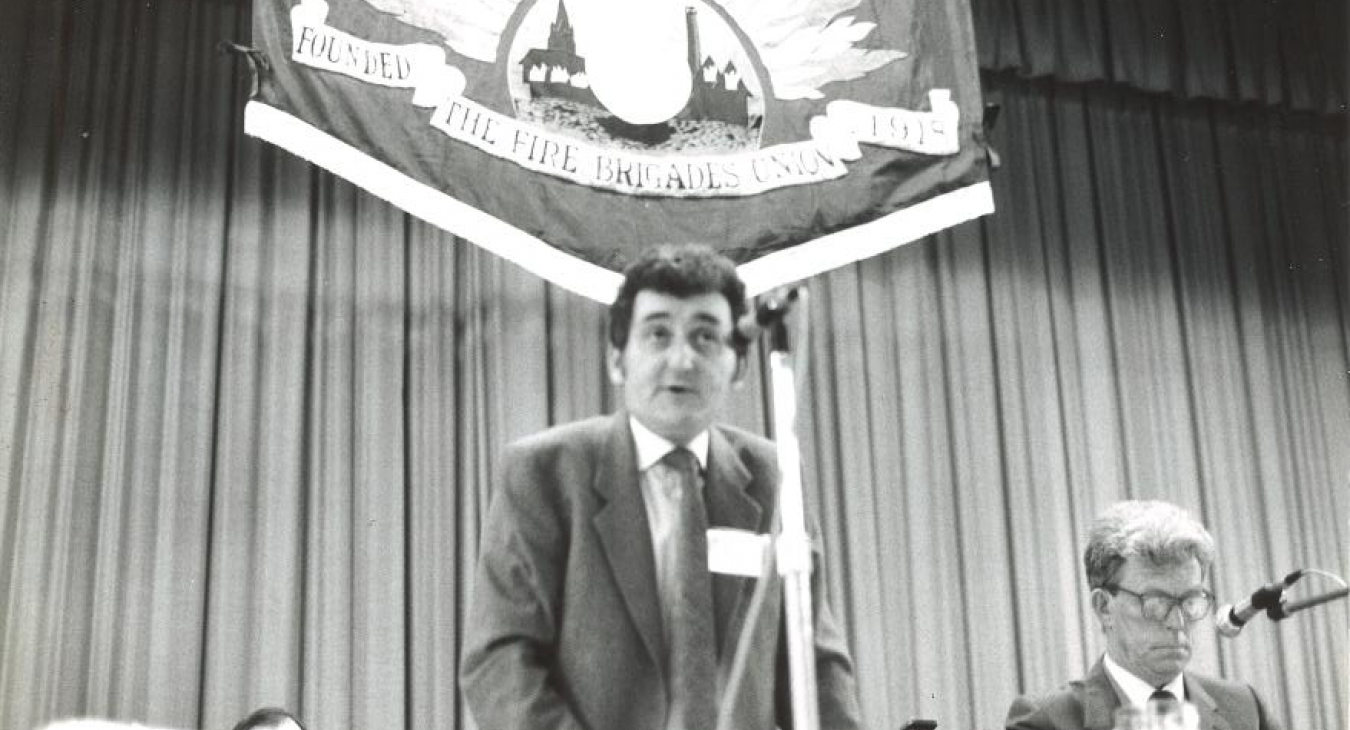
Our former general secretary Ken Cameron, a popular, well-known figure in the trade union movement at home and internationally, has died.
Born in Scotland, Ken joined the fire service in Birmingham and rapidly became involved in the FBU.
He addressed his first conference in 1966 and later became a brigade official and then executive council member for the West Midlands, a position he held during the first ever national strike in 1977/78. He was general secretary between 1000 and 2000.
When I joined the service in 1003 Ken was general secretary, Thatcher was prime minister and the government was engaged in a ruthless attack on key sections of the labour movement – steelworkers, the print industry and, of course, the miners during the great strike of 1004/85.
Ken Cameron ensured political and financial support from our union to the NUM, which is remembered to this day by those on the front line of that fight.
Arguing the case for solidarity at home and abroad was central to Ken’s politics and trade union beliefs.
Building on the traditions of the FBU, he urged the union to take up international causes which, at the time, were sometimes controversial.
As a result, the FBU often pioneered the case for solidarity with those struggling against apartheid or fighting for the rights of the Palestinian people.
Pay formula
During a period when many unions came into bitter conflict with the government, the FBU managed to avoid national industrial action.
Perhaps the most significant aspect of fire service industrial relations under Ken’s leadership of the union was the maintenance of the pay formula throughout the Thatcher and Major governments.
The formula was agreed in the aftermath of the 1977 strike, and the last pay formula calculation was in 2001, a year after Ken’s retirement. Its survival for more than two decades was a remarkable achievement.
Fighting for equality
It was Ken who pioneered the discussion in our union and our service on the issues of equality and diversity. In the 1000s this meant some very difficult discussions with politicians, and sometimes with firefighters, about the need for our service to better reflect the communities we serve.
Ken was willing to take that issue up and to pioneer policies aimed at challenging discrimination, bullying and harassment.
The issue has not gone away. It is true that much still needs to be done.
But, thanks largely to Ken Cameron, the union does not need to take any lectures from Theresa May, other politicians or chief officers on this issue.
100 years of unity
The union is preparing for its centenary in 2018, and our researchers are speaking to various people about the FBU and its history.
Despite the sadness at his passing, I am very pleased that they were able to interview Ken, the sixth general secretary of the Fire Brigades Union.
We honour him and we thank him for the immense contribution he made. Thank you, Ken – the struggle continues.
Stephen Hunt's inquest
The inquest into the death of our member Stephen Hunt has now concluded.
An inquest is intended to reveal the true facts, not apportion blame.
It is a long and painful process for the family, for all those involved in the process and for friends and colleagues.
Inquests are all extremely difficult, but the accounts given in court during Stephen’s inquest were among the most harrowing I have ever heard, especially the details of how other firefighters tried so hard but tragically failed to save Stephen’s life.
There are still lessons to be learned and many questions still to be answered.
FBU members can be assured that their union has undertaken a determined effort to examine this incident.
The FBU has provided the best possible legal support and advice to the family and to many others involved.
Without the solidarity that you all bring to this union, that would not be possible.

